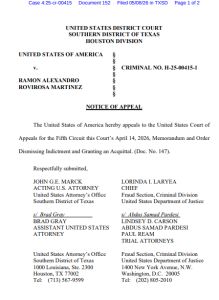
The DOJ appealed Judge Kenneth Hoyt’s ruling in the Southern District of Texas last week, challenging his decision to dismiss the criminal indictment against Rovirosa and grant a full acquittal on Sixth Amendment grounds.
Hoyt’s dismissal turned on a straightforward Confrontation Clause failure. The government introduced Spanish-to-English translations of WhatsApp messages among alleged co-conspirators without calling the translators as witnesses. Under Crawford v. Washington, 541 U.S. 36 (2004), testimonial statements require the declarant be available for cross-examination. The translators were available. The government intentionally left them off the witness list.
DOJ Attorney Bennett Starnes made it worse by twice promising forensic copies of the original Spanish-language screenshots, on September 26 and October 1, 2025, and never delivering them. During deliberations, the jury asked for the Spanish messages. The court couldn’t provide them because the government hadn’t entered them into evidence.
Hoyt didn’t mince language on the government’s workaround. Relying on Special Agent Maria Elena Varga to certify the translations, he ruled, “turns on its head the science and art of proper translation.” That’s a direct finding that the prosecution substituted an agent’s opinion for the constitutional right to cross-examine the actual translators.
Now the DOJ takes its case to the Fifth Circuit. It will have to convince a panel that Hoyt misread Crawford and its progeny, a steep climb when the record shows prosecutors had the translators and chose not to call them.
Rovirosa has been ordered released. The appeal clock is now running.
—James Okafor