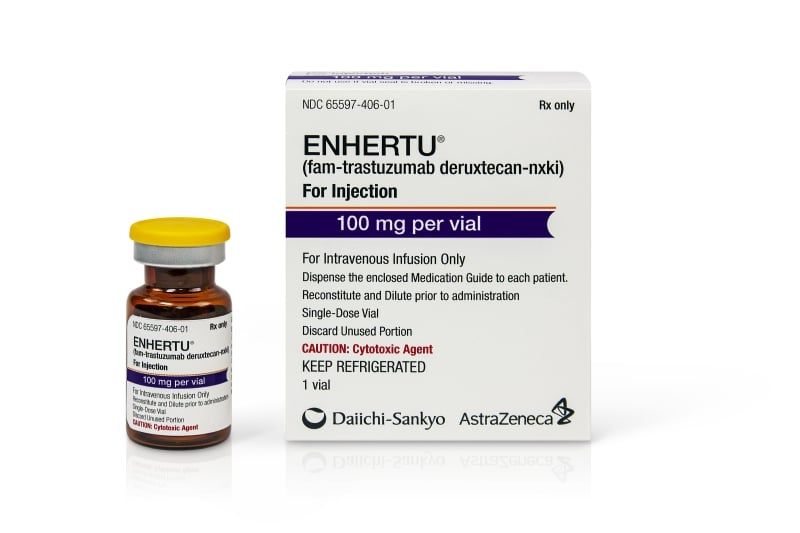
FDA cleared Enhertu for both neoadjuvant and adjuvant treatment of HER2-positive early breast cancer on Friday, giving Daiichi Sankyo and AstraZeneca a dual approval that arrived nearly two months ahead of the original July 7 decision date. The drug is already tracking $5.4 billion in projected global sales for fiscal 2026.
The adjuvant label comes with a catch. Patients who received Enhertu before surgery can’t continue on it post-operatively. Daiichi and AZ had sought a broader label covering prior Enhertu neoadjuvant use, but that didn’t pan out. The cleared indication covers patients with residual invasive disease following trastuzumab, with or without Perjeta, and taxane-based treatment.
The trial data is hard to argue with. Destiny-Breast05 showed Enhertu cut the risk of invasive disease recurrence or death by 53% versus Roche’s Kadcyla. The neoadjuvant Destiny-Breast11 study posted a pathologic complete response rate of 67.3%, compared with 56.3% for the dose-dense doxorubicin and cyclophosphamide followed by THP regimen.
Kadcyla had been counting on adjuvant use as its last growth runway in U.S. breast cancer after losing the metastatic setting to Enhertu. That runway just got shorter. Reimbursement for retreatment of patients who got Enhertu as neoadjuvant therapy is an open question: Destiny-Breast05 didn’t enroll prior Enhertu patients, and the adjuvant label explicitly excludes them.
Combined Q1 2026 sales jumped 31% to $1.4 billion. Daiichi’s five-year plan targets total sales above 3 trillion yen by fiscal 2030, with Enhertu as a core pillar. Patient protection on the drug runs to 2035.
— Sarah Chen