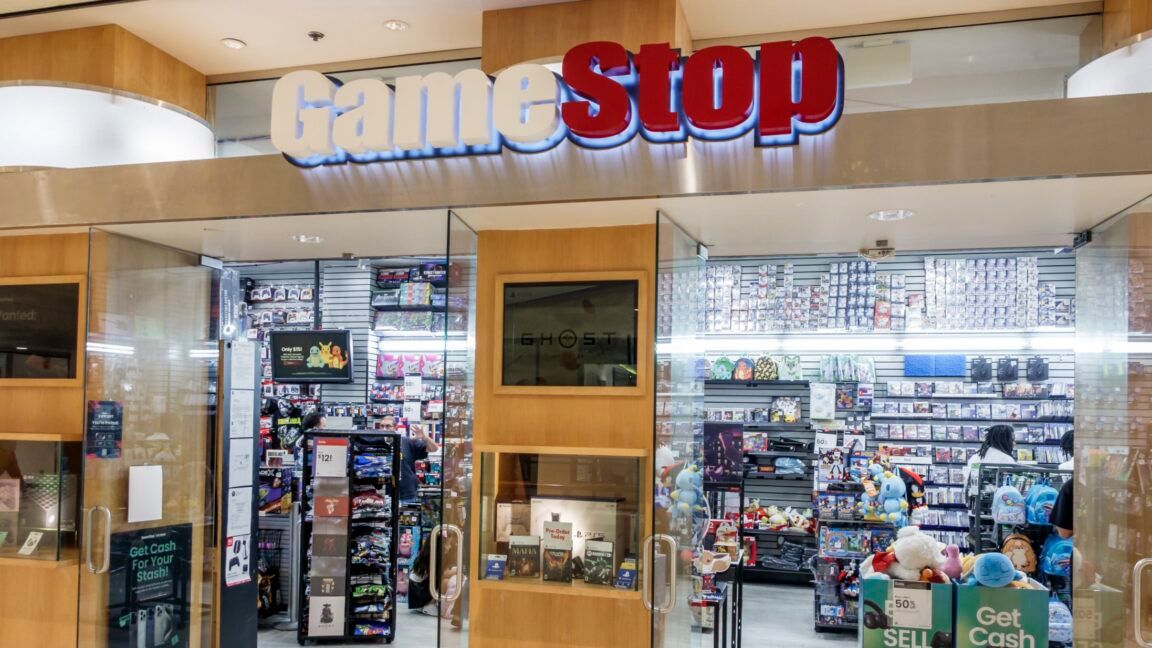
GameStop made an unsolicited $55.5 billion offer for eBay, at $125 a share, half in cash and half in GameStop stock. That’s a 46 percent premium to eBay’s closing price on February 4, the day GameStop began accumulating a 5 percent stake in the company.
The math doesn’t hold. GameStop has roughly $11 billion in market cap, $9.4 billion in cash and liquid investments, and a TD Securities “highly-confident” letter for up to $20 billion in debt. That’s about $40 billion. CNBC’s Andrew Ross Sorkin pointed out the $16 billion gap on live TV; Ryan Cohen’s answer was “we’ll see what happens.”
What does GameStop actually get? eBay runs a third-party marketplace with 135 million active buyers and reported Q1 2026 revenue of $3.1 billion, up 19 percent year over year. Cohen’s pitch is that GameStop’s ~1,600 US stores supply authentication hubs, drop-off nodes, and live commerce studios for eBay sellers. Morgan Stanley called the business models “fundamentally different”: eBay takes no inventory risk; GameStop is primarily a wholesaler.
Cohen’s cost-cut thesis targets $2 billion in savings: $1.2 billion from eBay’s $2.4 billion sales and marketing spend, $300 million from product development, and $500 million from G&A. If it closes, Morgan Stanley said it could become the largest leveraged buyout ever, surpassing the recently announced $55 billion Electronic Arts deal.
eBay’s board said it will review the proposal. It also noted it had no discussions with GameStop before the offer arrived.
Cohen’s answer to the $16 billion gap: “we’ll see what happens.”
Diana Kowalski