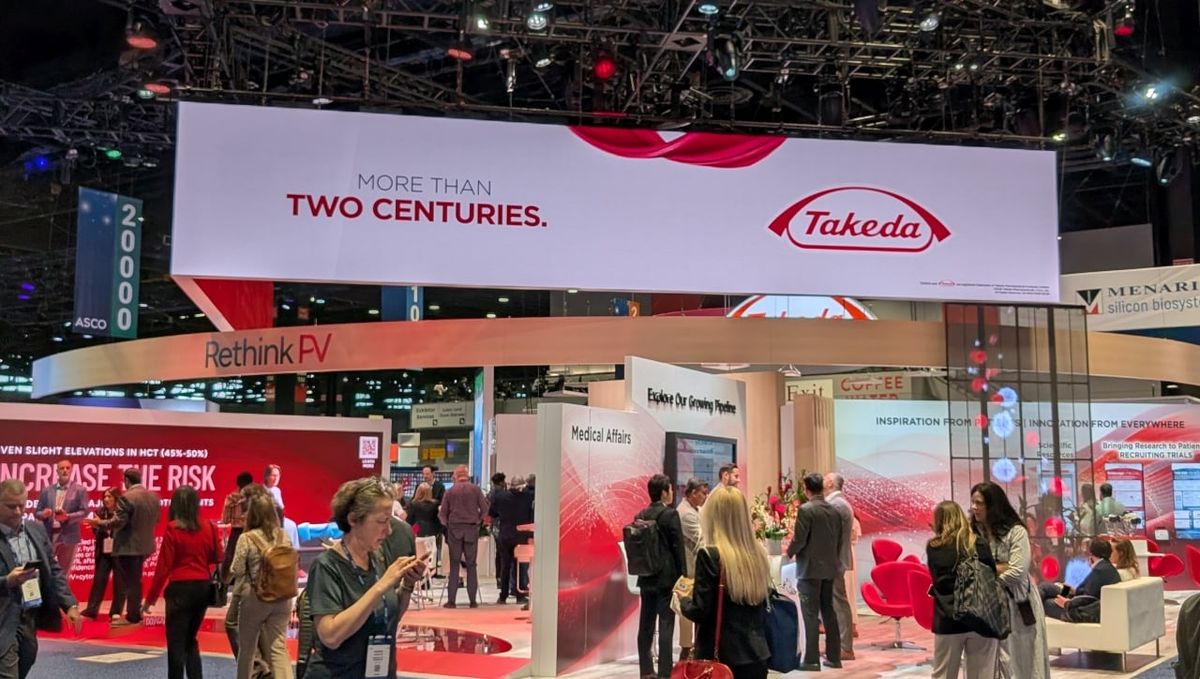
At ASCO on June 1, IBI363 long-term phase 1 data put 47.8% of immunotherapy-resistant squamous NSCLC patients alive at 24 months. That’s from 67 squamous patients divided across dose levels, with the 3 mg group posting median OS 18.2 months, median PFS 10.1 months. In adenoNSCLC, the 24-month OS came in at 42.7%, with median OS 15.2 months.
The survival read is the first real test of Takeda’s $1.2 billion upfront bet on Innovent’s oncology pipeline, signed October 2025 alongside up to $10.2 billion in milestones. The deal splits development costs 60/40, co-commercializes in the U.S. on the same ratio, and gives Takeda exclusive rights outside the U.S. and China.
IBI363 is a PD-1/IL-2 bispecific — PD-1 block prevents T-cell exhaustion while IL-2 acts within the tumor microenvironment to expand tumor-specific T-cells. That design matters because IL-2’s history in oncology isn’t clean: BMS’s deal with Nektar Therapeutics for a different, systemically active IL-2 conjugate collapsed in pivotal failure, precisely because systemic activation couldn’t be separated from toxicity at effective doses. Innovent’s approach confines IL-2 signaling to the tumor microenvironment, which is the mechanism the prior generation couldn’t deliver. Same cytokine, different architecture.
For Takeda, 47% two-year survival in a population that’s already failed prior checkpoint therapy is the data point justifying an $11.4 billion total commitment. Smoking history emerged as a positive efficacy signal in adenoNSCLC patients, a subgroup interaction MarsLight-11 will need to account for.
IBI363 holds FDA fast-track designation as a later-line squamous NSCLC treatment. MarsLight-11 is actively enrolling squamous patients post-platinum and anti-PD-1/L1 progression. The non-squamous phase 3 remains pending regulatory communications.
— Rebecca Lauren